




Safe Unlocking
Safe Unlocking in Oakland County, Howell, and Holly, MI
Getting locked out of your own safe is more common than most people expect, and getting back in takes more than patience and a YouTube video. The right approach depends entirely on what type of lock your safe uses: mechanical dial, electronic keypad, or physical key. Each type fails differently, requires different tools, and responds to different solutions. LKE Locksmith provides safe unlocking for residential and commercial customers throughout Holly, Howell, Oakland County, and the surrounding Michigan area.
Mechanical Dial Safes

Our skilled locksmiths can unlock safes with traditional combination dials (shown), electronic keypads, and keyed locks.
A mechanical combination dial works by aligning a specific sequence of moving parts at very precise positions. The dial has to be turned in the right direction, stopped at the correct numbers, without accidentally passing any of them, or the lock will stay shut. The margin for error on a quality mechanical safe is small, and one missed stop means starting the entire sequence over. On older safes, worn parts can make consistent alignment even harder to achieve.
When the correct combination is known but the safe still will not respond, the issue is usually technique: dial speed, number of rotations, or a stop that landed slightly off. When the combination itself is unknown, such as with an inherited safe, a safe that came with a property you purchased, or one where the combination was never properly recorded, manipulation by a skilled technician is often the first step. A locksmith who understands mechanical safes knows how the locking mechanism works and uses that knowledge to find the point of entry without damaging anything. For high-security mechanical safes where manipulation is ruled out, an auto-dialer can systematically work through combinations, though this takes considerably longer. Either way, the goal is the same: try everything that leaves the safe intact before moving on.
Electronic Keypad Safes
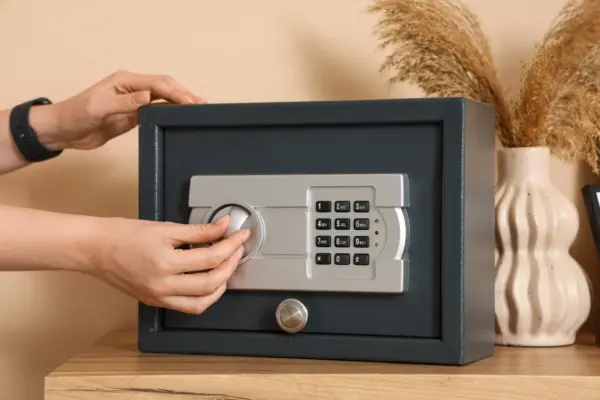
If the electronic keypad lock on your home jewelry safe stops working, give us a call!
The most common reason an electronic keypad safe lock stops working is dead batteries. Many electronic safes give no low-battery warning before the keypad stops responding, so a safe that worked fine yesterday may be completely unresponsive today. Replacing batteries regularly is the simplest way to avoid this. Before anything else on a non-responsive electronic safe, we check the battery compartment. Many manufacturers design battery access on the exterior so batteries can be swapped with the door still closed, and a fresh set usually gets things working again without any further intervention.
When batteries are not the cause, the approach depends on the make and model. Many electronic safes have a backup access option built in:
- Physical override key stored behind a side panel or cover
- Master override code set by the manufacturer at the factory
- Reset procedure outlined in the owner's manual
Default codes and manufacturer override sequences are worth working through before any further steps are taken. When the keypad unit itself has failed rather than just the battery, a replacement keypad may restore access. Biometric safes that use fingerprint recognition follow a similar path: battery and sensor checks first, before any conclusion that the lock itself has failed.
Key Lock Safes
Safes secured with a physical key create their own problems when the key is lost, broken, or simply unaccounted for. A locksmith can often pick or impression a key lock safe open without any damage to the unit, depending on the lock type and quality. For lower-security key locks, cutting a replacement key is also possible if the safe has a key number on the lock face or if the manufacturer keeps records on file.
High-security key locks resist these approaches by design. If picking is not an option and no replacement key can be sourced, the choice comes down to drilling or reaching out to the manufacturer about a factory override. The right call depends on the safe's age, its value, and how urgently access is needed.
When Drilling Is the Only Option
Drilling is a last resort. We reach for it only after every other approach has been exhausted: no workable combination, no accessible override, no way to clear the bolt work from outside. Drilling opens the safe, but it permanently destroys the lock and usually leaves the safe body unusable. A drilled safe is rarely worth repairing unless the body still provides meaningful fire resistance or the value of the contents justifies rebuilding it.
Before we start, we walk you through exactly what drilling involves, what the safe will look like when it is done, and whether buying a replacement makes more practical sense. You make the call. More detail on the safe drilling process is covered separately.
Legal Considerations
Before any work begins, we confirm that the person in front of us is the legal owner of the safe. Opening a safe for someone who does not have the right to access it creates legal exposure for everyone involved. We ask for ID and, where the situation warrants it, documentation that ties you to the safe or the property: a receipt, a deed, a lease, or a photo ID matching the address. If you are acting on behalf of an estate or a business, having that paperwork ready before we arrive keeps things moving. The verification step is there to protect you as much as it protects us.
Safe Unlocking Across Oakland County and Howell
LKE Locksmith provides safe unlocking from our Holly storefront, with walk-in availability Monday through Friday from 9:00 a.m. to 3:00 p.m. Mobile service is available Monday through Friday from 9:00 a.m. to 5:00 p.m. for customers across Holly, Fenton, Clarkston, Waterford, Howell, Grand Blanc, Davisburg, Linden, Hartland, and the wider Oakland County area. We are fully insured, have been in business since 2011, and bring over 35 years of combined hands-on experience to every job. The full range of what we offer, including safe combination changes, keypad installation, drilling, and safe sales, is available on our safe services page. Contact us today to schedule safe unlocking or ask a question.
Safe Unlocking FAQs
What is safe unlocking, and how do you help me regain access?
Safe unlocking is the process of opening a safe when you cannot access it with the right combination, a working keypad, or the physical key. A professional locksmith evaluates the lock type, the lock mechanism, and the safe door so we can use the safest method to regain access.
Can you open a combination safe if I forgot the numbers?
Often, yes. With mechanical safes that use a combination dial, we first confirm ownership and permission, then determine the best approach. If you still have partial information, such as the first, second, or third number, that can help, but we can also assist when the full safe combination is unknown.
How do I dial a mechanical combination lock correctly?
Many safes require a very specific sequence. Typically you turn the dial to the first number, then change direction and continue in the correct order. People often miss it by accidentally passing a number, turning too fast instead of dial slowly, or not following the correct left and right pattern such as dial left and counter clockwise steps. Your user manual or owner’s manual usually lists the correct sequence and where the dial should stop.
My electronic safe will not open. Could it just be dead batteries?
Yes. Dead batteries are one of the most common reasons many electronic safes will not open. If your safe has a battery compartment you can reach, you may be able to replace batteries and try again. It is also smart to replace batteries regularly to avoid a lockout.
Do you use non-destructive methods first?
Whenever possible, yes. We prioritize non-destructive methods to avoid damage to the safe and its internal components. If a non-destructive option is not possible based on the safe design, security level, or failure, we will explain alternatives, including when a safe may need to be drilled open.
Can you open a key lock safe or make replacement keys?
If you have a key lock safe and the key is missing, we can evaluate the key lock and your options for opening it. In some cases, replacement keys may be possible depending on the safe and what information is available. We will also check if the safe uses an override key in addition to a combination or keypad.
Are master override codes or default codes safe to try?
Many manufacturers do not use universal master override codes, and trying random codes can waste time or trigger lockout behavior on some electronic locks. If you have the default code from the paperwork or a trusted source, follow the manufacturer’s instructions in the user manual. If you do not, it is usually better to call a locksmith rather than guessing.
What do you need from me before you open a safe?
There are important legal considerations. We require explicit permission from the legal owner or an authorized representative before performing safe unlocking. When you call, be ready to share the safe type, its location, and any details you have, such as whether it is a mechanical dial or an electronic keypad.